
February 2026
Early 2026 brought some significant advances to the NLRP3 therapeutic landscape, with Insilico Medicines receiving IND approval from FDA for a potential best-in-class NLRP3 inhibitor, entering Phase I clinical trial for Parkinson’s disease, and Monte Rosa Therapeutics, Inc. announcing positive interim results from a Phase 1 clinical study of MRT-8102, a novel molecular glue degrader (MGD) targeting NEK7 to treat NLRP3-driven inflammatory conditions.
In this blog post, we introduce the NLRP3 protein and the regulatory role of its kinase partner NEK7. We then explore how structural insights have paved the way for the development of Monte Rosa’s molecular degrader therapeutic strategy, which led to these promising clinical outcomes.
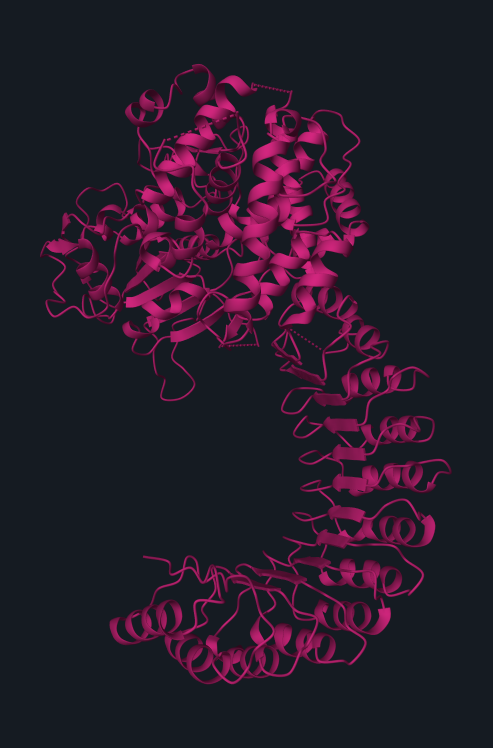
NLRP3
NLRP3 (NACHT-, leucine-rich-repeat-, and pyrin domain-containing protein 3) is a cytosolic multi-protein complex that detects cellular stress and triggers immune responses (inflammasome). While this is essential for fighting infections, aberrant NLRP3 activation drives a spectrum of chronic inflammatory diseases, making NLRP3 one of the most relevant clinical targets against inflammation-driven human diseases.
Despite its clinical relevance, direct targeting of NLRP3 has proven remarkably difficult. The protein’s large, dynamic structure and the complexity of its activation mechanism have limited the success of conventional small-molecule inhibitors. MCC950, a compound that inhibits NLRP3 by blocking its ATPase activity, showed promise in preclinical models but encountered setbacks in clinical development due to hepatotoxicity.
Other inhibitors are currently under investigation, but none have yet reached regulatory approval.
The novel approach recently reported by Monte Rosa Therapeutics has focused on centrosomal NIMA-related kinase 7 (NEK7). NEK7 is a serine/threonine kinase that plays an essential role in regulating NLRP3 inflammasome assembly, making it an attractive upstream target for inflammation. Rather than inhibiting NEK7’s kinase activity or blocking its interaction with NLRP3, the molecular degrader approach eliminates NEK7 entirely, thereby preventing NLRP3 activation at its source.
Structural Insights into NEK7 degradation for NLRP3 regulation
Recent structural studies have elucidated NLRP3-NEK7 interaction and functional mechanisms, opening the opportunity for the development of NEK7 degraders as a novel therapeutic strategy to modulate NLRP3-driven inflammation.
NLRP3-NEK7 complex
Inflammasome activation requires NLRP3 to transition from a closed cage-shaped assembly into the active, disk-like inflammasome. A recent cryo-EM study from Johnson & Johnson elucidated the central role of NEK7 in the intermediate steps that precede this transformation. Upon binding with NLRP3, NEK7 disrupts the large, inactive NLRP3 oligomers, breaking them down into NEK7:NLRP3 monomers and dimers. In the absence of NEK7, NLRP3 remains trapped in non-productive, higher-order assemblies and cannot proceed toward activation and thus, trigger inflammation.
The cryo-EM structure of the NLRP3:NEK7 complex (PDB: 8SXN) reveals that:
NEK7 makes extensive contacts with the inner (concave) face of the NLRP3's leucine-rich repeat (LRR) domain. This interface largely overlaps with the regions that NLRP3 uses to form its inactive oligomers.
Structural comparison between the NLRP3 closed oligomeric inactive forms and the NEK7:NLRP3 complex shows steric clashes between NEK7 and the adjacent NLRP3 protomer within the NLRP3 hexamer. Docking analyses further indicate similar clashes with other oligomeric forms (e.g., closed cage and open octamer).
By occupying NLRP3 oligomerization interface, NEK7 effectively prevents NLRP3 subunits from self-associating into these higher-order, inactive states, promoting their dissociation into smaller, activation-competent NEK7:NLRP3 complexes.
These structural findings demonstrate that the NEK7:NLRP3 complex is a critical intermediate that enables NLRP3 to progress toward its active architecture. NEK7 functions as a molecular wedge that unlocks NLRP3’s activation pathway.
From Structure to Therapy: a NEK7-Targeted Degrader Approach
The structural story behind NLRP3, NEK7, and its CRBN-mediated degradation
Rather than attempting to target the NLRP3-NEK7 protein-protein interaction with a traditional competitive inhibitor, Monte Rosa Therapeutics scientists’ strategy was to eliminate NEK7 entirely, using molecular glue degraders (MGD). MGD works by inducing proximity between a target protein and an E3 ubiquitin ligase - such as cereblon (CRBN) - leading to target ubiquitination and proteasomal degradation.
The researchers noticed that clinically active MGDs exploiting the CRBN ubiquitin ligase, recruit their targets through a common recognition motif known as the β-hairpin G-loop degron, which is a simple secondary structure element with a high prevalence in the human proteome.
Therefore, they conducted a systematic exploration of the CRBN target space, computational mining 3D structure information, which led to the identification of previously uncharacterized β-hairpin G-loop proteins, including NEK7, that held the premise for being targets of CRBN-mediated degradation. As NEK7 carried the desired recognition motif, several compounds were tested to ensure they not only induced proximity (stabilizing a ternary complex with CRBN) but also induced degradation. The crystal structure of the ternary complex of NEK:CRBN:MGD with the most promising ligand (MRT-3486) was elucidated (PDB: 9NFQ):
NEK7 binds the CRBN:MRT-3486 interface through its β-hairpin G-loop centered around G57 in the vicinity of the imidazopyridine ring of the MGD molecule, forming a H-bond network with CRBN.
On top of the interactions at the G-loop level, NEK7 engages CRBN directly via its N-terminal residues (NEK7: L22, P24, D25). Deletion of these residues completely suppresses the MGD ligand-mediated degradation of NEK7, demonstrating that this extended protein-protein interface of NEK7 with CRBN is critical for target recruitment and degradation.
By recruiting NEK7 to the CRBN E3 ligase complex, the MGD small molecules effectively remove the NLRP3 activation partner, suppressing NLRP3 inflammasome-mediated inflammation and explaining the positive clinical outcome of this therapeutic strategy.
Conclusion
Monte Rosa’s discovery exemplifies how understanding the structural basis of the NLRP3 inflammasome activation mechanism could open the door to therapeutic innovation, translating a basic science discovery (the NLRP3:NEK7 complex's key role in inflammasome activation) into a new therapeutic modality.
References:
Yu, X., Matico, R.E., Miller, R. et al. Structural basis for the oligomerization-facilitated NLRP3 activation. Nat Commun 15, 1164 (2024). https://doi.org/10.1038/s41467-024-45396-8
Petzold, G. et al. Structural motifs enable diverse substrate recognition by the CRBN E3 ubiquitin ligase. Science (2024). https://doi.org/10.1126/science.adt6736